
When people think about exercise and mental health, the focus often falls on how hard or how long they exercise. But new research suggests that another factor may be just as important, and possibly more important: how regularly you exercise.

A large Norwegian study has found that students who were physically active less often were more likely to develop depression, anxiety, or another common mental health disorder during the following year. Interestingly, the frequency of exercise showed a more consistent relationship with mental health outcomes than either workout intensity or duration.
The research was conducted by Michael Grasdalsmoen of Western Norway University of Applied Sciences and colleagues and was published in PLOS ONE.
Why Exercise Habits Matter for Students

Depression and anxiety are among the major causes of disability affecting young adults. University and higher education can be a particularly challenging period, as students may face academic demands, financial pressure, changes in social relationships, disrupted routines, and separation from family or familiar support networks.
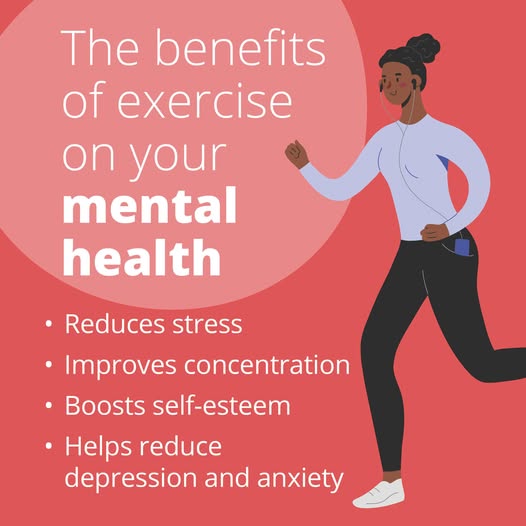
Exercise has long been associated with better psychological well-being. However, much of the existing research has relied on measurements taken at a single point in time. This makes it difficult to determine whether exercise habits are associated with mental health outcomes that develop later.
The Norwegian researchers wanted to investigate this relationship more closely. They followed 10,460 full-time students between the ages of 18 and 35, recording their physical activity habits and then assessing their mental health approximately one year later.
Regular Movement Appears to Be Important

At the beginning of the study, participants provided information about several aspects of their exercise habits. Researchers considered how frequently they exercised, how demanding their activities were, how long individual sessions lasted, and how much exercise they accumulated during a typical week.
After one year, the students completed a standardized self-administered assessment designed to identify common mental disorders.
The results showed a clear pattern: students who were less physically active overall were more likely to meet criteria for depression or anxiety at follow-up.
Of the different exercise characteristics examined, frequency demonstrated the most consistent association with later mental health.
This does not necessarily mean that intensity and duration are irrelevant. The researchers found differences between men and women. Among women, lower exercise intensity was associated with a greater likelihood of anxiety and depression. Among men, shorter total weekly exercise duration appeared to be more strongly associated with mental health risk.
More Exercise Was Associated With Lower Risk
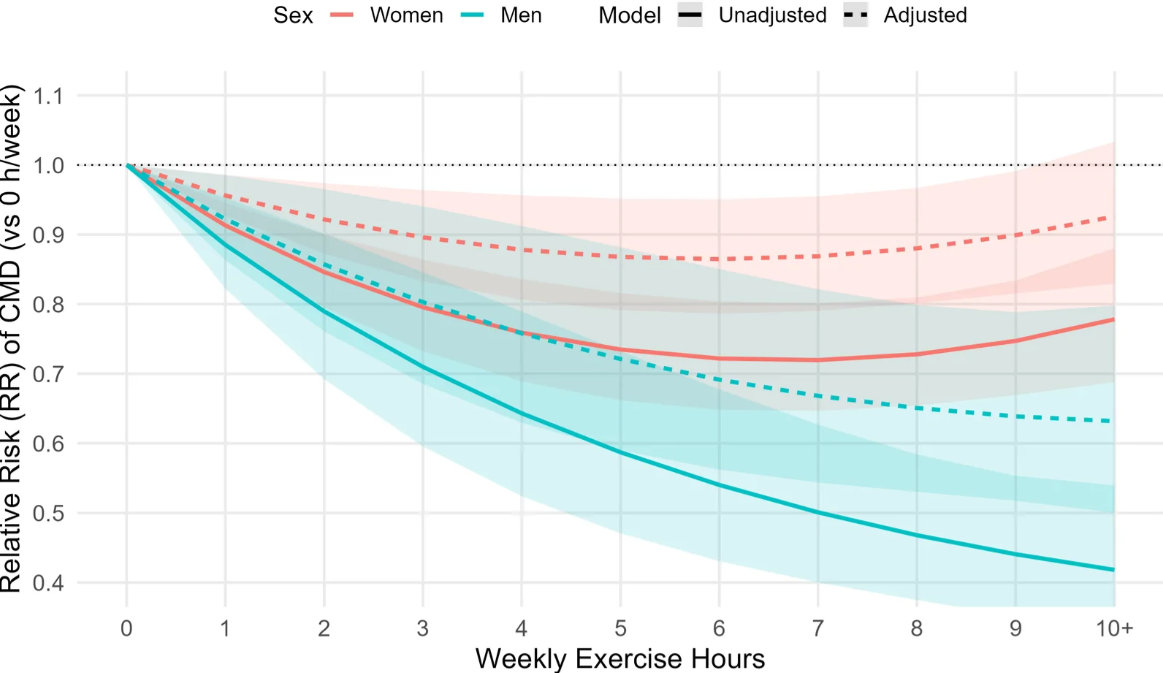
The study also found that the likelihood of developing a common mental disorder generally decreased as total weekly exercise increased, with the relationship continuing up to roughly 10 hours of exercise per week.
However, this should not be interpreted as a recommendation that everyone needs to exercise for 10 hours every week.
In fact, the findings were compatible with existing public-health recommendations, including the World Health Organization’s recommendation that adults accumulate at least 150 minutes of moderate-to-vigorous physical activity each week.
The broader message may be more useful: exercise does not necessarily have to consist of occasional, extremely demanding workouts to support mental well-being.
Consistency May Beat Occasional Intense Workouts
For someone with a busy schedule, this distinction could be particularly important.
Instead of exercising very hard once or twice a week and remaining inactive on the other days, it may be more practical to incorporate movement into a regular routine. Walking, cycling, resistance training, recreational sports, or other forms of physical activity can all contribute to an individual’s overall activity level.
Regular movement may also be easier to maintain over the long term than an exercise routine built around exhausting sessions.
The study therefore adds to the idea that exercise habits should be viewed as a pattern rather than simply a weekly total. How consistently someone moves may have meaningful implications for psychological health.
The Study Does Not Prove Exercise Prevents Mental Illness
There is an important limitation to consider.
Because this was an observational study, the researchers cannot establish that exercising more frequently directly prevented depression or anxiety. Other factors could influence both exercise behavior and mental health.
The relationship could also work in the opposite direction. Students beginning to experience depression or anxiety may become less motivated, less energetic, or less interested in exercising. In that case, declining physical activity could partly be a consequence of worsening mental health rather than its cause.
For this reason, the results should be interpreted as an association rather than proof of a cause-and-effect relationship.
Nevertheless, the findings suggest that encouraging regular physical activity could be one component of broader strategies aimed at supporting student mental health, particularly among people beginning to experience psychological difficulties.
The Bigger Picture
The study’s main message is relatively simple: when it comes to exercise and mental health, consistency may matter considerably.
You do not necessarily need to push yourself to your physical limits every time you exercise. Building a sustainable routine that keeps you moving regularly may be a more realistic approach to supporting long-term well-being.
For students dealing with academic pressure, irregular schedules, and other challenges associated with higher education, making physical activity a regular part of everyday life could therefore be more valuable than focusing exclusively on achieving the hardest or longest possible workouts.
The research does not establish exercise as a replacement for professional treatment of depression or anxiety. Instead, it adds another piece to the growing body of evidence suggesting that regular physical activity can be an important part of a broader approach to mental health.
Source research: Physical exercise and risk of common mental disorders among higher education students: A national prospective study, published in PLOS ONE in August 2026.
SOURCE LINK: https://pubmed.ncbi.nlm.nih.gov/42616683/
Related Posts